 Property managers juggle countless responsibilities, from tenant requests to building maintenance to vendor coordination. Integrating artificial intelligence into your property management system is one of the most effective ways to reduce that burden, keep properties performing well, and keep tenants satisfied.
AI in property management refers to using intelligent software to automate, analyse, and improve the day-to-day tasks that traditionally required manual effort. It could be a chatbot automatically triaging a tenant's maintenance request, a machine learning model predicting which HVAC unit is about to fail, or an analytics dashboard flagging which properties are underperforming and why. Done right, AI doesn't replace the property manager but makes them significantly more effective.
Discover Work Orders for Property Management
Explore our platform here.
AI in Property Management: What the Data Shows
The shift from experimentation to implementation is now well underway across the property management industry. Deloitte's 2026 Commercial Real Estate Outlook found that 76% of commercial real estate firms are already exploring or implementing AI, signalling that meaningful engagement with the technology has become the industry norm rather than the exception. For property managers, this is no longer a question of whether competitors are exploring AI, most already are. PropRiseAdoption is also accelerating on the ground. Buildium's 2026 State of the Property Management Industry Report found that 58% of property management companies now say they use some form of AI, a majority that reflects how rapidly the technology has moved from early-adopter novelty into mainstream operations. Chatbots handling tenant enquiries, automated lease renewals, and AI-assisted maintenance scheduling are no longer leading-edge; they are fast becoming baseline expectations.
AI Is Becoming Part of the Asset Itself
For property owners and managers already deploying AI at scale, the operational picture is changing fundamentally. PwC and the Urban Land Institute's Emerging Trends in Real Estate 2026 (based on surveys and interviews with over 1,750 industry professional) describes AI becoming part of integrated property-wide systems, supporting lease management, energy monitoring, predictive maintenance, tenant communication, and investment decision-making. Assets equipped with advanced digital infrastructure are increasingly viewed as more controllable, more efficient, and ultimately more valuable. The technology stack is becoming inseparable from the asset itself.Tenant Communication and Request Handling
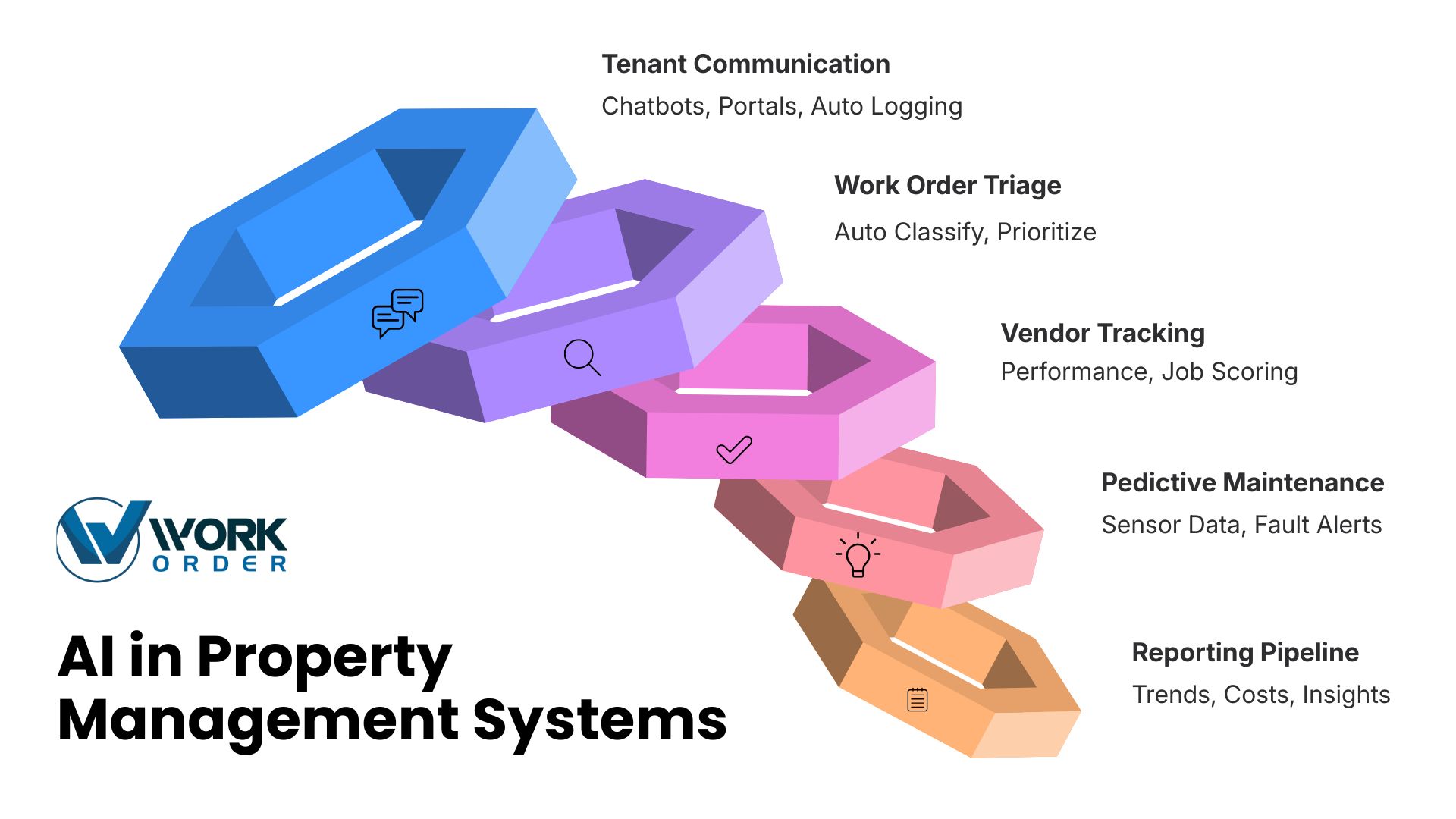
One of the most common applications of AI in property management is handling tenant communication. AI-powered chatbots and self-service portals allow tenants to submit maintenance requests, ask questions about their lease, or report issues at any time of day without needing to reach a staff member directly.These systems are trained to understand natural language, so tenants can describe a problem in plain terms and the AI will interpret it, log it, and route it appropriately. Every interaction is recorded automatically, creating a clear and searchable history without relying on phone notes or email chains.
For more complex issues that require a human decision, the system escalates the request to the appropriate staff member with the relevant context already attached.
Work Order Classification and Prioritization
When a maintenance request comes in, AI can classify it by type and urgency without a manager having to manually review and sort it. For example, a report of no heating in winter would be flagged as high priority and routed for same-day attention, while a request for a replacement light bulb would be queued as low urgency for the next scheduled maintenance visit.Classification is based on the language used in the request, historical data about similar issues, and predefined rules set by the property management team. This reduces the time between a request being submitted and work being assigned, and helps ensure that urgent issues are not overlooked during busy periods.
Predictive Maintenance
 Traditional maintenance operates reactively where something breaks and then it gets fixed. AI enables a more proactive approach by analyzing data from building systems to identify signs of potential failure before it occurs.
This works by collecting data from sensors installed on equipment such as HVAC units, elevators, boilers, and electrical systems. The AI analyzes patterns in that data such as changes in temperature, vibration, energy consumption, or run times then compares them against historical performance to flag equipment that may be approaching failure. Maintenance can then be scheduled during a convenient window rather than responding to an emergency breakdown.
This approach reduces unplanned downtime, extends the life of equipment, and generally costs less than emergency repairs.
Vendor and Contractor Management
AI tools track vendor performance across every job by logging response times, completion rates, and repeat issues, building an objective record over time. Rather than relying on informal assessments or memory, property managers have access to clear and consistent data on every contractor in their network. This makes it easier to identify which vendors deliver reliable results and which are falling short. When new work comes in, AI can recommend the most suitable contractor based on their track record, trade specialization, and availability. It can also automatically flag expired licenses or insurance certificates before a job is assigned, reducing compliance risk without additional administrative effort.Workflow Automation
AI is used to keep maintenance and operations workflows moving without requiring manual follow-up at every step. A typical automated workflow might look like this: a tenant submits a request, the AI classifies and assigns it, the assigned contractor receives the details, automated updates are sent to the tenant as the job progresses, and the work order is closed once completion is confirmed.This reduces the administrative effort required to manage each job and ensures consistent communication with tenants throughout the process without a staff member having to send individual updates.
Data Analysis and Reporting
Over time, property management platforms that use AI accumulate a significant amount of operational data. This data can be analyzed to identify patterns and trends that would be difficult to spot manually — for example, which properties generate the most maintenance requests, which repair categories are recurring, or where energy costs are running above expected levels.This kind of analysis helps property managers make better decisions about capital expenditure, preventive maintenance schedules, vendor contracts, and building improvements. It also supports more accurate budgeting by providing a clearer picture of historical maintenance costs and likely future needs.
What AI Does Not Replace
 It is worth noting that AI in property management is a tool, not a replacement for experienced staff. Decisions that involve judgment, negotiation, tenant relationships, or complex compliance matters still require human involvement. AI handles the high-volume, repetitive, and data-heavy parts of the job — freeing up managers to focus on the work that genuinely requires their expertise and attention.
The technology works best when it is implemented thoughtfully, with clear processes, trained staff, and regular review of how well it is performing against the goals it was set up to meet.
Try setting up your property management work order system.
Start exploring Work Order here.